 Zawanah
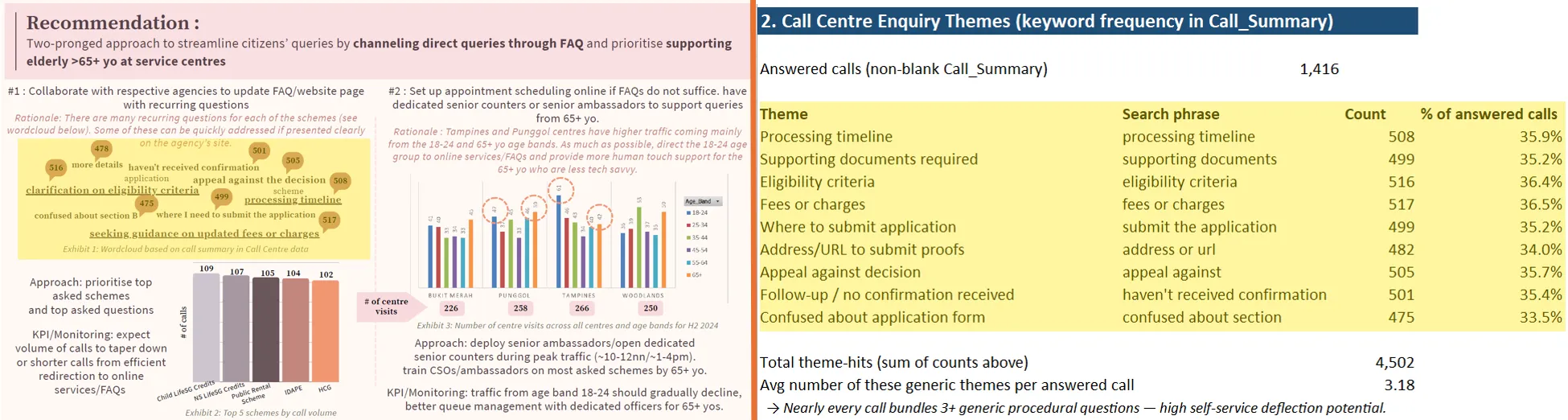
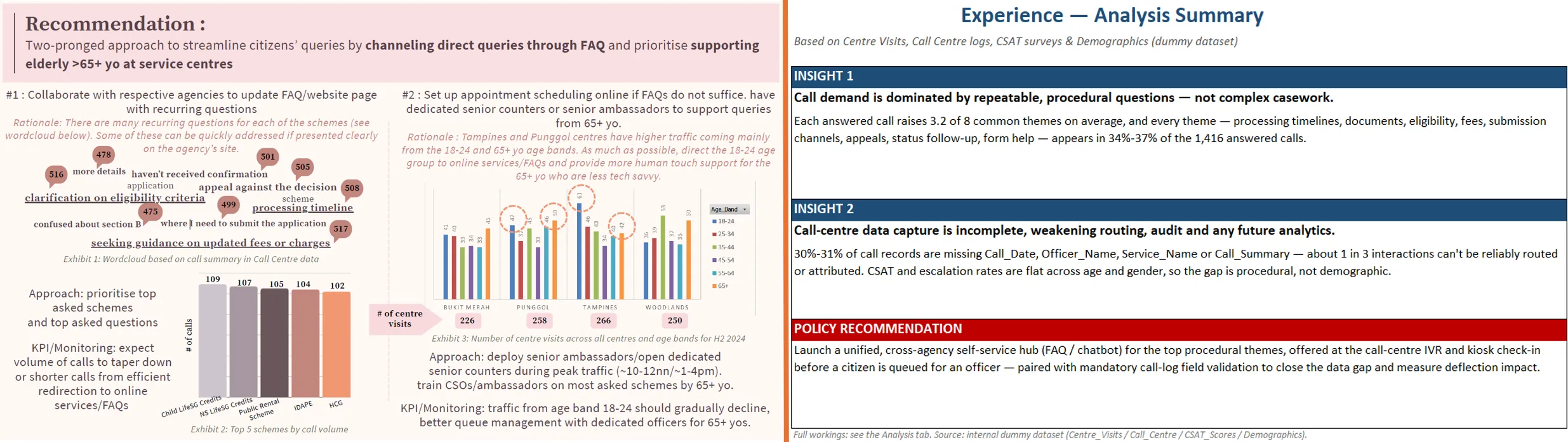
 A year ago, I did a technical assessment on improving service delivery and came up with a two-pronged policy recommendation.
I tasked Sonnet 5 to work on the same assessment to see how its analysis compares - whether there are aspects that I had not covered, or if it could come up with more innovative recommendations that had not occurred to me.
A note on the data: This is based on a technical assessment I completed for an analyst role, using mock data. The data is generic enough to apply to any service delivery organisation.
Context and Data
The dataset comprise :
- centre visits data (arrival time, time served, queue number, topic(s) queried, contact number),
- call centre records (questions asked, officer name, age range, gender, contact number)
- customer satisfaction scores for each case, and
- demographics (age range, gender) by contact number
The objective of the assessment is to derive 1-2 insights and recommend a policy or process intervention to improve customer experience.
A Decent First Pass
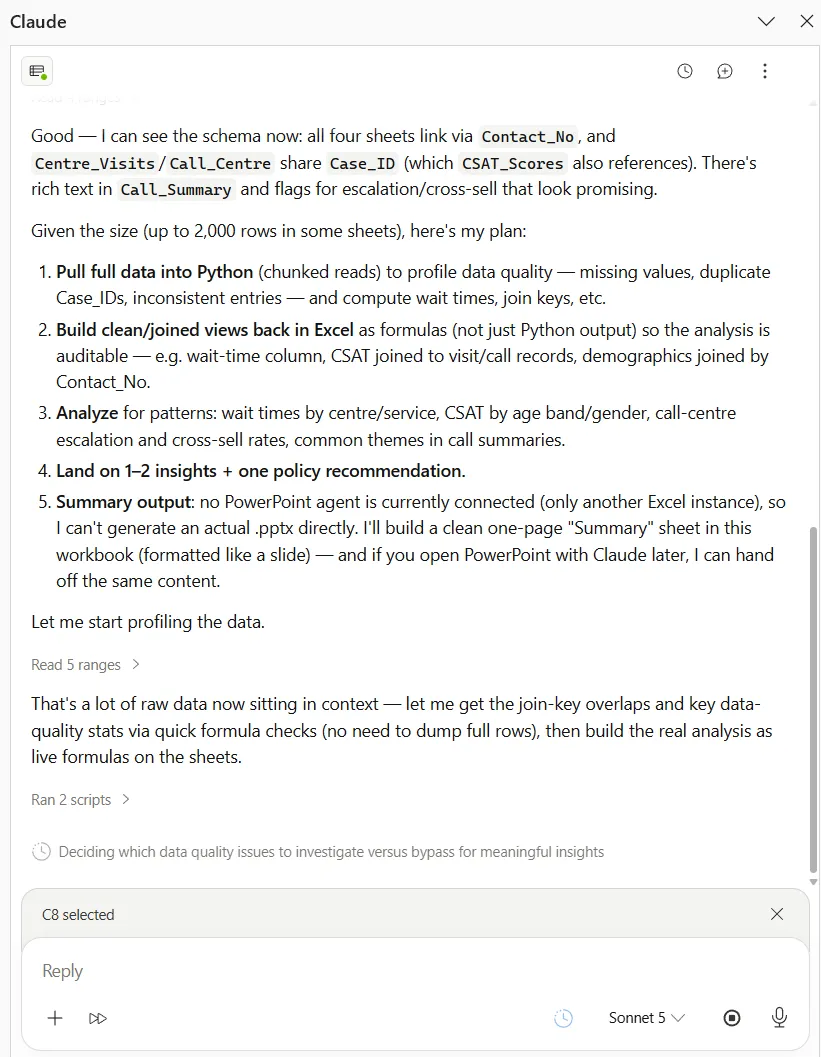
Sonnet 5 started with a sensible plan: understanding the relations between excel sheets, making data transformations for analysis, then analysing and finally producing the required insights and policy recommendation.
Several of its findings converged with mine:
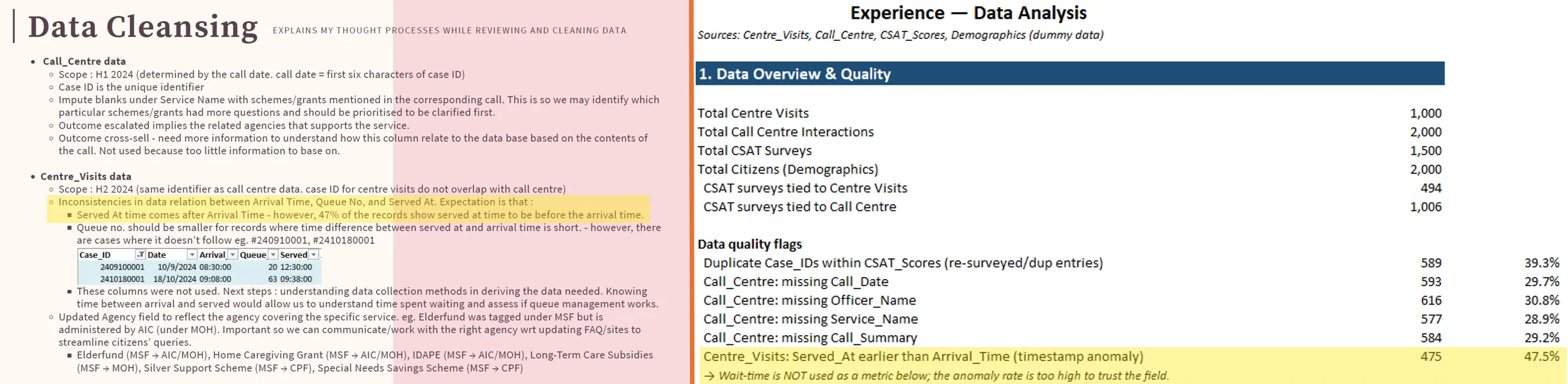
- Identifying a serious timestamp anomaly affective arrival and service times
- Found recurring themes across customer calls; and
- Recognised an opportunity to divert repeatable enquiries towards self-service via an FAQ or chatbot
It also explored escalation rates across age groups, which was an angle that I excluded from my analysis.
Key Differences
1. Timestamp Anomaly leading to Operational Considerations
Both Sonnet and I found that 47.5% of the relevant records contained anomalies across the Arrival_Time and Served_At fields. The problem was severe enough that waiting time could not be used reliably, even though it should have been a core service-delivery metric.
My original assessment went one step further: if waiting time matters operationally but cannot be measured, the organisation should investigate how those timestamps are captured.
The analytical finding was not only that “this column is unreliable.” It revealed a failure in the measurement process that would prevent the service from understanding and improving customer experience.
While Sonnet correctly flagged the data-quality issue, an analyst would connect it to an operational cause, and a corrective action.
2. Calculation leading to Decision Impact
Sonnet calculated escalation rates across age groups but I had excluded the escalation field because only ~15% of it was populated.
A blank could not safely be interpreted as “no escalation”; it could just as easily mean the outcome had not been recorded. Due to this ambiguity, I would not build a customer policy around the result.
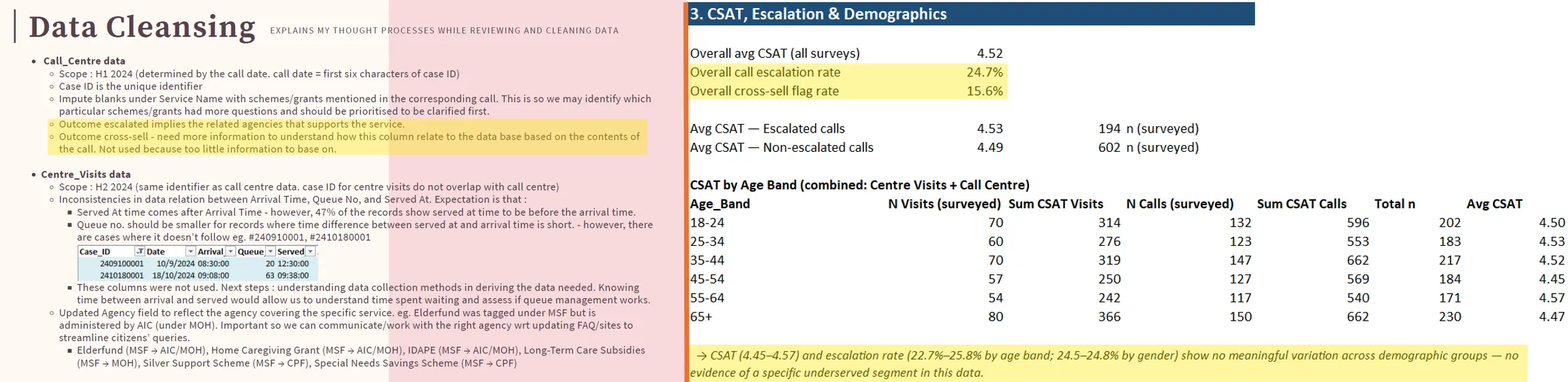
Since Sonnet’s analysis did not produce a meaningful difference between age groups, it did not lead to a misleading recommendation.
But based on this occurrence, it is probably wise for a human analyst to decide what level of coverage, consistency and ambiguity is acceptable for the decision at hand.
3. Blanks could be reasonably Imputed
In the call-centre data, Service_Name was empty in 577 rows, giving the field a missing-data rate of 28.9%.
Sonnet’s initial analysis reported the missingness but did not attempt to recover the values. I then asked it to check whether the service name could be extracted from Call_Summary.
It found that 405 of those rows contained exactly one known service name in the text. Because the value was already present elsewhere in the same record, this was deterministic extraction rather than statistical imputation. Recovering those values would reduce the missing rate from 28.9% to 8.6%, while leaving 172 genuinely unrecoverable rows blank.
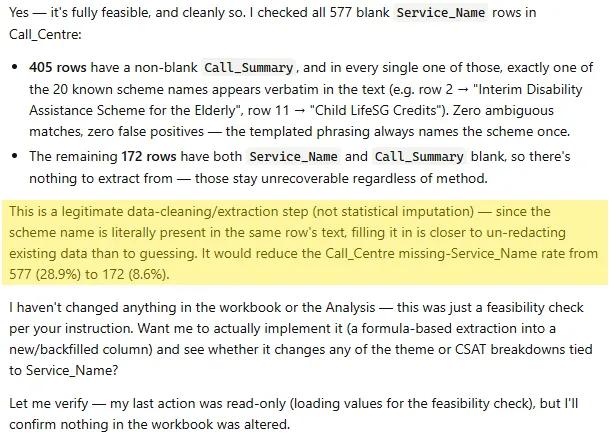
In this case, I identified a cross-field recovery opportunity and although Sonnet didn’t, with my prompting, it could check all affected rows and verify whether the rule could be applied consistently.
4. Context informs Intervention
Both our analyses found recurring call themes which led to our similar recommendation of creating an FAQ or chatbot that could handle common, repeatable questions and reduce avoidable demand on the call centre.
While that was a reasonable recommendation, but Sonnet addressed only one channel.
My analysis also examined physical service-centre visits. The mock data showed different age profiles across locations, with meaningful groups of both younger and older visitors. Based on the accompanying demographic information, I proposed retaining targeted in-person support, including dialect-speaking assistance for older visitors during peak periods.
That recommendation would still need to be validated against actual language preference, demand and service-centre capacity before implementation. It connected customer characteristics, channel behaviour and the organisation’s service role to a more specific intervention.
Additionally, I included implementation priorities and KPIs so that the policy could be tested and refined rather than treated as a one-off recommendation.
AI for an Analyst
Based on this experiment, I would use LLMs for breadth of analysis but keep human analysts accountable for scoping (eg.missingness thresholds), contextual interpretation and action.
Note that this experiment is not a controlled benchmark. It’s based on one mock dataset and one initial run through using Sonnet in Excel. I did not compare completion time, review time or repeated runs, and there was no independent evaluator scoring both submissions.
Here’s how I would probably work with LLMs at each stage of analysis:
| Stage | Model | Human |
|---|---|---|
| Data Cleansing & Data Quality | Inspects the dataset, find relationships between data, quantify missing data, and propose analysis exploration | Review the anomalies highlighted by model in dataset, define and decide the minimum data threshold to drop, impute, or discard the fields. Guide direction of exploration based on context and objective. |
| Exploratory Data Analysis & Insights | Runs approved data cleansing steps and proceeds with exploration, and share insights valuable to the objective, considering context. | Assess logical flow of insights and that it is grounded based on data. Consider how insights can be framed into recommendations based on organisational context. |
| Recommendations | Can make recommendations | Validates feasibility, approves the intervention and tracks KPIs. |
While models inform, humans are better off making key design decisions.
Since I’ve started with Sonnet, I might try this on Opus and Fable, also, GPT 5.6 Sol/Terra/Luna.