 Zawanah
 Dear Diary, how am I doing?
Journaling is a research-backed practice that helps organise our thoughts, process emotions, build self-awareness, and aligning daily actions to our core values.
But the book-and-pen version of journaling has never stuck for me. While I like the idea of organising my thoughts, becoming more self-aware, and checking whether my daily actions align with my values, I can’t commit to taking out a notebook at the end of a long day and writing from a blank page. 🥲
So I built a journaling agent that I can chat with. 🙂
Entries
I wanted to keep track of my thoughts and actions throughout the day. With a busy schedule, it’s hard to keep a mental reminder to log entries.
So I had my agent nudge me twice a day - in the morning @ 8am and in the evening @ 8pm.

- At 8am, Pepys asks for one sentence: what is the one thing I am moving today?
Amidst all the to-dos for the day, this keeps me focused to have at least 1 non-negotiable win for the day.
- At 8pm, it asks for my mood, my energy and a sentence for the day.
I wanted to document the day, and how I felt about it so I can monitor how actions or events shift my mood and energy and with this data, calibrate myself in future.
Voice notes can also be used to document the day. Groq has a free tier voice transcription option.
This solves the first friction I have with journaling: documenting. Next is synthesising daily records into useful summaries to learn from.
Weekly & Monthly Reflections
At the end of the week, Pepys provides me with a summary of events that happened for the week, how my mood and energy has changed during the week, including:
- what I have accomplished that brought me closer to my goals
- what is the gap to reach my goals, and
- what I need to think about and how I want to show up for the upcoming events
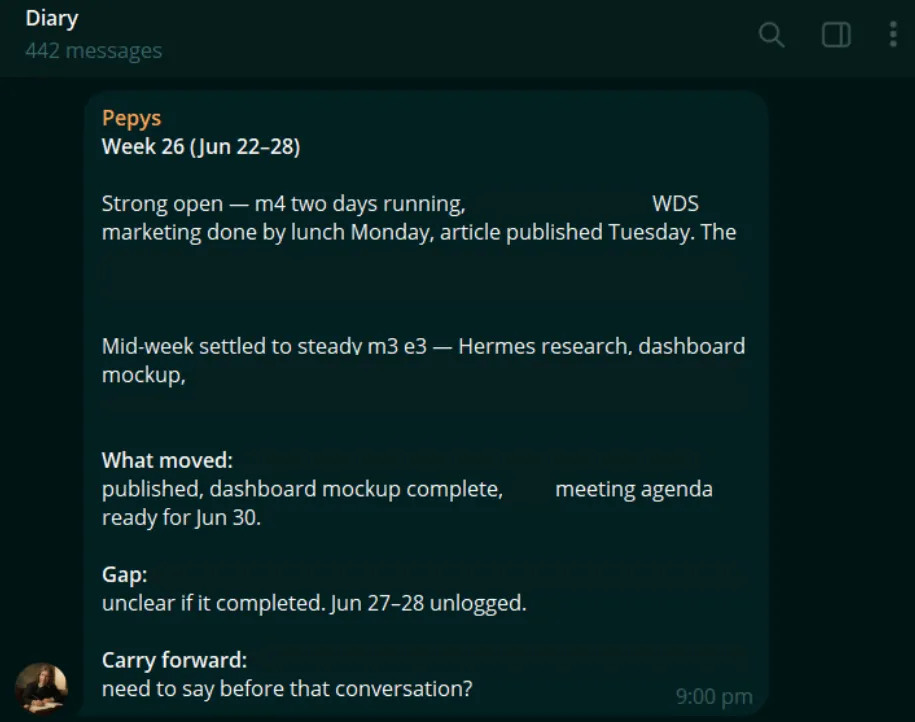
This helps me stay focused on longer-term goals and how I can calibrate my actions the following week.
As weeks accumulate into months, it recognises patterns about me that I could learn from.
Here’s an interesting one:
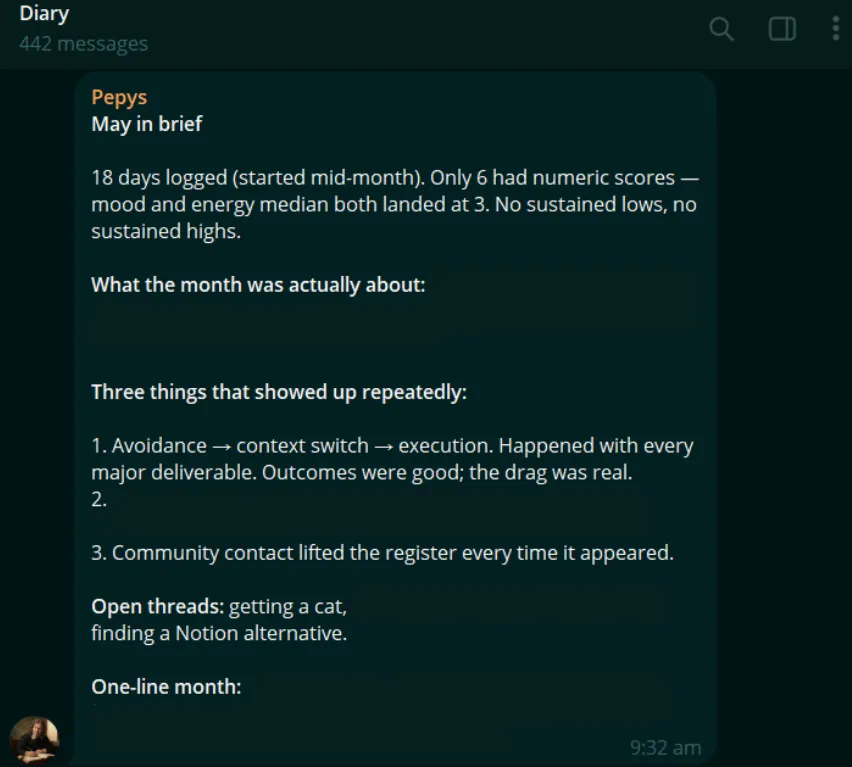
It recognised a recurring theme where I was avoiding things I was supposed to do, but when I context switched (eg. played my ukulele, go for a run, talk to people etc.), then I somehow get rejuvenated and could execute well on the thing I was initially avoiding.
With this knowledge, I learnt that I work more effectively when I take intentional breaks that shift me into a different mode (ie. physical, social or creative), before returning to the task with renewed energy.
Insights like these are what keep me consistent with journaling through Pepys. By offering a consistent, outside, perspective, it recognises patterns in my behaviour that I might not have noticed on my own.
Personalisation
To make the experience even more personalised, I provided it results of my personality tests so it customises the weekly reviews based on it.
Note: Personality tests serve as guides, and are not fixed definitions of who a person is. They capture tendencies at a particular point in time, shaped by context and self-perception. People can change, adapt, and consciously choose how they respond. I use these results as prompts for reflection not as limits of who I choose to become.
| Assessment | What it helps understand | How to use it |
|---|---|---|
| Enneagram | A person’s underlying motivations, fears, and coping patterns | To examine why I react or behave in certain ways |
| Big Five (OCEAN) | Broad, measurable tendencies in how a person thinks, feels, and behaves | To understand general behavioural and emotional disposition |
| PRIOS | Leadership style, workplace priorities, and interpersonal approach | To reflect on how a person leads, collaborates, and operates at work |
| Attachment style | How a person responds to closeness, trust, dependence, and conflict in relationships | To recognise relationship patterns across different contexts |
Together, these assessments offer different lenses of a person:
- the Enneagram explores motivation,
- the Big Five describes traits,
- PRIOS examines workplace behaviour, and
- the Attachment theory highlights relationship patterns
So the weekly and monthly reviews get a holistic view of me as a person.
Pepys has made journaling easier for me to sustain, along with identifying my behavioural patterns that allow me to self-calibrate. While a typical journal preserves what I share and my thoughts, Pepys provides additional perspective on my life events, on top of documenting them.