 Zawanah
 This episode from Star Trek: Strange New Worlds was memorable. In this episode, Captain Pike is tasked with persuading the R’ongovians to ally with the Federation, but every diplomatic approach seems to fail. Mid-way, I was certain that there was no way he could win them over. But he eventually did, using an unconventional method: radical empathy and telling them that they shouldn’t ally with the Federation.
Strategic Territory
The premise is that the R’ongovians occupy a strategically important territory between Klingon and Romulan space (both of which are Federation’s geopolitical rivals). Going through the R’ongovian territory is the fastest route to the other side of the Beta Quadrant. Without the R’ongovians’ permission, the Federation keeps losing ships attempting the passage.
Therefore, an alliance (with the R’ongovians) would provide safer access and at the same time, prevent either the Klingons or Romulans from gaining control of an important route. In other words, R’ongovians’ decision could shift the balance of power in the Beta Quadrant.
So the Federation is eager to secure the R’ongovians’ support, and have tasked Captain Pike to negotiate with the R’ongovians.
The Beginnings of Negotiation
Pike started with a textbook pitch when presenting the Federation; that it is democratic, its members have a voice, and its strength come from cooperation.
When that did not work, Pike was told that empathy is a defining quality of the R’ongovian people. And that their behaviour is also inconsistent, depending on who they speak with.
They mirror the characteristics or personalities of the person they are speaking with. For example, being formal and analytical when speaking with Spock (a Vulcan ie. highly logical)
When I watched the scenes of the R’ongovians engaging in a discussion with various Federation individuals (adopting different diplomatic approaches), it was quite frustrating because it appeared as if the R’ongovians were mocking whoever they are speaking with and not actively trying to reach an understanding to move the discussion forward.
Why R’ongovians mirror their counterpart
However, Pike realised that it was diagnostic. R’ongovians do that to enter the other party’s mode of thinking to discover whether that party can reciprocate (and enter their own).
A particularly strong argument the R’ongovians made was in the discussion with Spock. Spock approached from a deterrence angle by warning them about Klingon cultural domination, but the R’ongovians turned it back on the Federation.
If the concern is cultural survival and the Federation alliance promises cooperation, cooperation can also produce homogenization and what would happen to the small R’ongovian culture inside a powerful system? Will R’ongovians retain its identity or will it slowly become another Federation-shaped society?
Spock acknowledges the difficulty of living away from Vulcan and the cultural sacrifices required by Starfleet.
While Pike was instructed to remain an observer, he interrupted to defend Spock, describing Spock’s service as a genuine sacrifice and honours his effort to understand cultures different from his own.
Although he violated their intructions for him to remain an observer, the R’ongovians responded positively to Pike because they are impressed by his willingness to defend another person’s perspective than by being a Federation boy scout. So they offered him a final opportunity to make Federation’s case for an alliance.
Radical Empathy
Pike said “Easy. You shouldn’t.” and he proceeded to make the strongest argument against the Federation’s objectives :
- An alliance would make the Federation’s enemies R’ongovia’s enemies. The Federation is only recently out of a Klingon war, the Romulans remain a threat, and new conflicts will inevitably emerge.
- Admitting that the Federation has not approached R’ongovia out of deep appreciation for its culture. It barely understands that culture. Its immediate interest is R’ongovian territory.
- R’ongovia might receive access to markets, scientific cooperation and protection—but those benefits are uncertain. Even Federation protection may become necessary only because the alliance exposes R’ongovia to Federation enemies.
The Federation has much to offer but its benefits carry a price and R’ongovia has legitimate reasons to conclude that this price is too high.
That is radical empathy. The R’ongovians were not merely copying their counterparts but rather, were testing whether another society could see the world from a R’ongovian position, and Pike demonstrated that.
The Negotiations were a test of Character, and Pike passed it
When the R’ongovia delegation leaves, they raised the Federation flag, signalling that they have chosen the alliance!
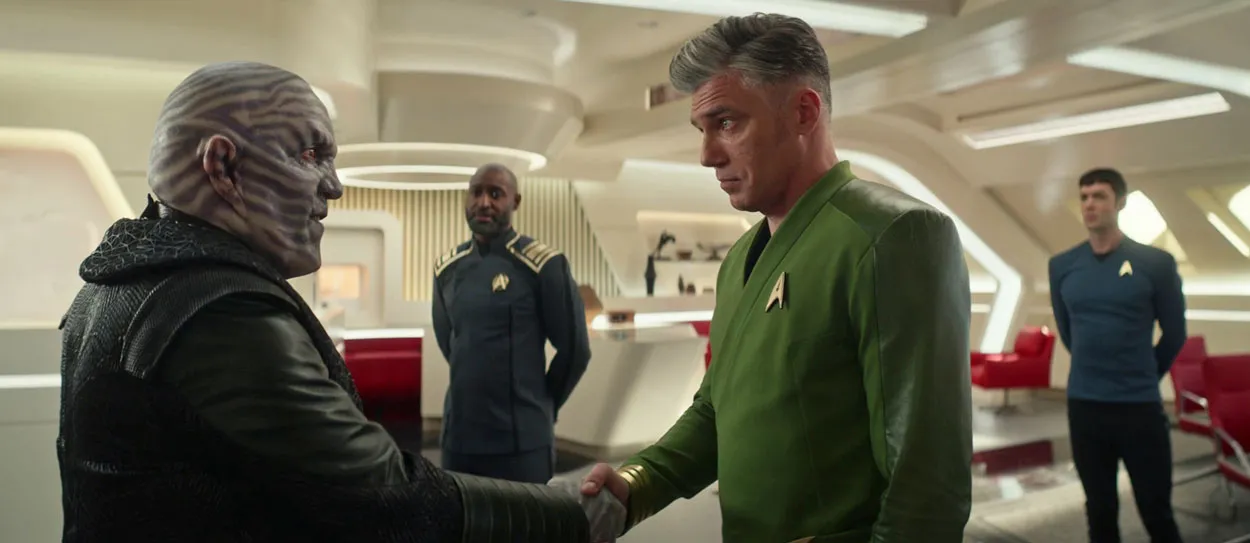
Let’s unpack why:
1. Recognising their autonomy
Every other argument made by various Federation representatives treated the alliance as favourable and the obvious conclusion for the R’ongovians.
By saying otherwise, Pike’s answer restored their right to decide that the Federation could be wrong for them, and that it may not necessarily be the best choice.
Research has found that when people feel that their freedom to choose is being threatened, they can become more motivated to disagree, a response psychologists call Reactance.
By removing the pressure of a “yes”, and a “no” being acceptable, the R’ongovians no longer have to resist.
2. Acknowledging the Federation’s self-interest
Pike articulated Federation’s self-interest openly, that the Federation needs the R’ongovian territory (more so than the R’ongovian needs the Federation).
As long as he presents Federation as purely benevolent or flawless entity, the R’ongovians will wonder what he is hiding.
Trust is built when Pike can be trusted to recognise the flaws of the Federation
3. Articulating their case without diminishing it
Pike listed all valid arguments for R’ongovians, without the “but..”
He makes a case for the R’ongovians very well, as if working through his decision models if he were a R’ongovian.
4. Demonstrating the Federation’s values instead of advertising them
Pike’s final argument seems anti-Federation, but his willingness to make it is evidence for the Federation at its best.
He demonstrates honesty, pluralism, respect for sovereignty and the ability to tolerate criticism. Basically saying “We want you, but we will not erase your perspective in order to obtain you.”
That is what the R’ongovians needed to know.
Managing Difficult Conversations
At the beginning, it appeared as if the R’ongovians were being really difficult.
Most difficult conversations contain more than one kind of resistance. Someone may feel misunderstood, but they may also be working toward different goals, protecting themselves from blame or operating with fewer resources than we realize.
Radical empathy helps as a test of whether the disagreement is due to a misunderstanding. Research on high-quality listening suggests that feeling heard can reduce defensiveness and encourage more reflective thinking. Perspective-taking can also help negotiators uncover interests and possible trade-offs. But neither can remove a genuine conflict of incentives, personal risk or capacity.
Once a person no longer has to fight to make their perspective visible, we can discover whether the remaining problem requires a better conversation, a better deal, stronger safeguards or additional resources.